
 DiaDent
 Dia-Duo GP Obturation Tips, 4/Box · 25G
DiaDent Dia-Duo GP Obturation Tips, 4/Box: 2 items, 2 Gauge options, pack of 4. Select the gauge to see its part number.
| Part no. | Gauge |
|---|---|
| 4007-2120 | 23G |
| 4007-2121 | 25G |
Product
- Manufacturer
- DiaDent
- Manufacturer #
- 4007-2121
- Item code
- 110-1121
- UPC / Barcode
- 8806383557269
Catalog path
- Subcategory
- Obturation & Points
Ordering
- Status
- Sold out


Questions
Which gauge options are on this page?
This page carries 2 gauge options: 23G, 25G. Pick one to see its price, part number and stock.
How many come in a pack?
4 per pack; the price shown is per pack.
How do I find a specific part number?
The table above lists every part number on this page with its gauge. Searching the part number (for example 4007-2120) on this site opens the right page.
When does it ship?
In-stock orders placed before 3 PM ET ship the same day. An item we don't keep on the shelf shows its own ship-by date on its page, and you can cancel it for a full refund until it ships.Ground shipping is free over $49.
About gutta percha points
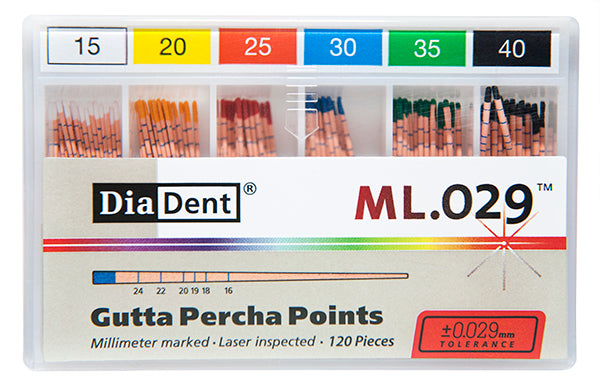
Gutta percha points fill the root canal of a tooth: gutta percha, made from the sap of certain tropical trees, is softened by heat and hardens as it cools. The FDA classifies gutta percha as a Class I device (21 CFR 872.3850). A point is mostly not gutta-percha: a stated composition is 20 percent gutta-percha, 56 percent zinc oxide filler, 11 percent barium sulfate as radiopacifier and 3 percent plasticizers. It becomes soft at 60 degrees Celsius and melts at around 95 to 100 degrees with partial degradation. Points come standardized, matching the taper and apical gauge of the instruments, or non-standardized with a variable taper whose tip is adjusted after gauging.
Obturation is the filling of the prepared canal system after it has been cleaned, to limit the ways reinfection can get in. Gutta-percha is the most widely used core material; what varies is how it is compacted and which sealer goes with it. The approaches named in the literature are cold lateral condensation, warm vertical or continuous-wave compaction, thermoplasticized injection, carrier-based systems and single-cone or sealer-based protocols.
ISO 6877 is the international standard for endodontic obturating materials; it sets the dimensions and gives the numerical and colour-coding systems for the sizes of preformed points. The standard notes that points are sold sterilized or non-sterilized and that sterility is not part of the standard.
How points, carriers and condensers differ
- Gutta Percha Points — The solid core of the filling, which has no adhesion to the canal wall on its own. Its thermoplastic nature and strong adherence to the dentine walls make complete removal difficult if the canal is ever retreated.
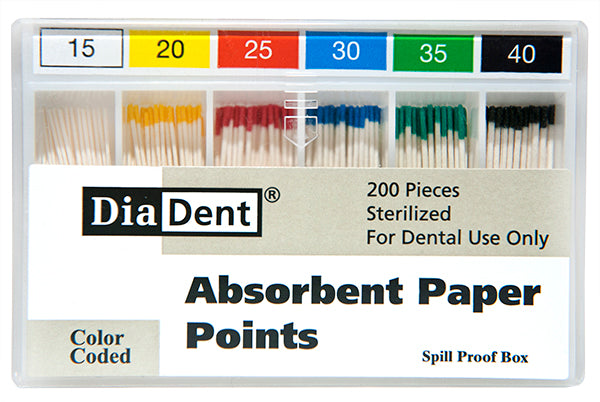
- Paper Points — Absorbs: it dries the canal or carries medication, where a gutta percha point stays in as the filling.
- Obturation Accessories & Heat Carriers — The instruments and the heat, rather than the material that stays in the tooth.
- Condensers & Pluggers — Presses the filling material into place; it does not cut the canal.
What to look at when choosing obturation materials
Technique: a systematic review of comparative clinical studies found no obturation strategy consistently ahead of the others across long-term outcomes. The same review names canal anatomy, operator experience, procedural efficiency, retreatment requirements and material handling as what the choice turns on.
Heat: the two phases of gutta-percha behave differently, the alpha form gluey and highly flowable when heated, the beta form stable and flexible at room temperature.
Removal later: one study reported rotary retreatment instruments clearing more of the old gutta-percha in less time than manual Hedstrom files.
Sources: Root Canal Obturation: An Updated Review of the Literature, 2026 (Dent J) · ISO 6877:2025, Dentistry — Endodontic obturating materials · FDA 21 CFR 872.3850, Gutta percha · Gutta-percha in endodontics: a comprehensive review of material science, 2019 (J Conserv Dent) · Comparison of the sealing ability of bioceramic sealer against epoxy resin based sealer: a systematic review and meta-analysis, 2023 (J Oral Biol Craniofac Res) · Comparative Evaluation of Efficacy of Gutta-Percha Removal in Root Canal Retreatment Using Manual and Rotary Instruments, 2025 (J Pharm Bioallied Sci) · FDA 21 CFR 872.3830, Endodontic paper point · ISO 3630-3:2021, Dentistry — Endodontic instruments — Part 3: Compactors · Time Required to Retreat Carrier-Based Obturation, 2026 (Dent J) · FDA 21 CFR 872.4565, Dental hand instrument