


DedecoShips in 3 business days
Dedeco Rubber Abrasive Wheels · 3" x 1/4" x 1/4" · Black – Coarse · Each
SKU 050-0201MFR# 0137
Size
3" x 1/4" x 1/4"
3" x 1/2" x 1/4"$27.95
3" x 1/4" x 1/4"$20.95
3" x 1/8" x 1/4"$15.95
4" x 1/2" x 1/2"4" x 1/4" x 1/2"$28.95
4" x 3/4" x 1/2"$57.95
6" x 1" x 1/2"$96.95
6" x 1/2" x 1/2"$78.95
6" x 1/4" x 1/2"$55.95
6" x 3/4" x 1/2"$92.95
Grit
Black – Coarse
Pack
Each
Each$20.95
The Dedeco Rubber ABRASIVE WHEEL 4" X 1/2" X 1/2" - Brown Extra Coarse Aluminum Oxide 1/Unit. #7A Wheel, 2.4 mm thick, 12/pk. Unmounted Dura-Green silicon carbide finishing wheel for porcelains and precious alloys. Catalog code 0151.
Product
- Manufacturer
- Dedeco
- Manufacturer #
- 0137
- Item code
- 050-0201
Catalog path
- Marketplace
- Laboratory
- Category
- Abrasives, Buffs & Brushes
- Subcategory
- Abrasive Wheels & Belts
Ordering
- Status
- Ships in 3 business days
More from Abrasive Wheels & Belts
Stocked in the same subcategory.



Keystone Industries
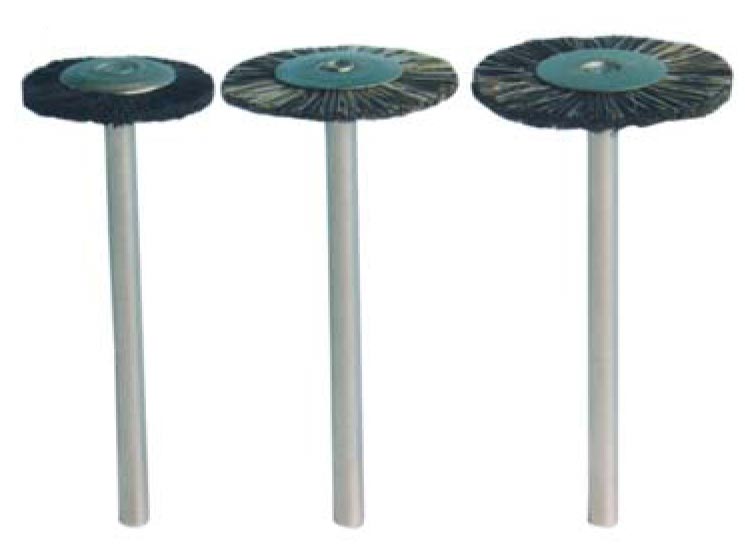
Keystone Scotch-Brite Miniature Brushes — 12/Pack
In stock
307 sold this monthfrom $18.82


Questions
What is Dedeco Rubber Abrasive Wheels used for?
The Dedeco Rubber ABRASIVE WHEEL 4" X 1/2" X 1/2" - Brown Extra Coarse Aluminum Oxide 1/Unit. #7A Wheel, 2.4 mm thick, 12/pk.
Which size and grit and pack options are on this page?
This page carries 10 size options: 3" x 1/2" x 1/4", 3" x 1/4" x 1/4", 3" x 1/8" x 1/4", 4" x 1/2" x 1/2", 4" x 1/4" x 1/2", 4" x 3/4" x 1/2", 6" x 1" x 1/2", 6" x 1/2" x 1/2" and 2 more. This page carries 5 grit options: Brown – Extra Coarse, Black – Coarse, Green – Medium, Red – Fine, Blue – Extra Fine. This page carries 1 pack option: Each. Pick one to see its price, part number and stock.
When does it ship?
In-stock orders placed before 3 PM ET ship the same day; anything not on our shelf ships within 3 business days.Ground shipping is free over $10.
About grinding wheels
A grinding wheel is made of abrasive particles held together by a bond and grinds with its rim. OSHA groups abrasive wheels by bond: organic, such as resin, rubber or shellac, and inorganic, such as clay, glass or porcelain.
OSHA defines a grinding wheel as abrasive particles held together by a bond and used for grinding on its rim. OSHA defines an abrasive belt as a power-driven, flexible, coated band used for grinding, polishing or buffing.
How the types on this shelf differ
- Grinding Wheels — The coarse step: it shapes the work and removes excess material.
- Flexible Silicone Polishers — The abrasive is embedded in a flexible silicone body.
- Polishing Wheels — A wheel for the smoothing steps that follow grinding.
- Buffing Wheels — Carries the polishing agent to the work.
- Abrasive Discs — Grinds and smooths with its face.
- Mounted Rubber Points — A rubber-bonded point already fixed on its own shank.
- Polishing Discs — The finer steps of the same series.
- Separating & Cut-Off Discs — A thin wheel for cutting, where an abrasive disc works on its side.
- Mounted Stones — A rigid bonded abrasive, for grinding and shaping.
- Ceramic & Porcelain Polishers — Polishes the ceramic itself, in place of a glaze layer.
Heatless wheels are also filed here; no source on our allowed list describes them, so this guide does not.
What to look at when choosing
Coarse tools shape the work and remove excess material; medium ones smooth out the grooves and scratches the coarse ones leave.
Surface: 0.2 micrometres of roughness is considered the threshold for a clinically acceptable restoration.
Speed: OSHA's abrasive-wheel rule has the spindle speed checked against the maximum operating speed marked on the wheel.
Reuse: the CDC states that burs, polishing points and rag wheels used on contaminated appliances or prostheses should be heat-sterilised, disinfected between patients, or discarded.
Dust: the CDC names grinding and polishing castings and porcelain among the laboratory steps that put dust in the air.
Sources: OSHA 29 CFR 1910.94, Ventilation (grinding, polishing and buffing operations) · OSHA 29 CFR 1910.211, Machinery and machine guarding: definitions · A Comprehensive Review of the Surface and Chromatic Properties of Monolithic Zirconia: Polishing and Finishing Methods (Cureus 2024) · Does Sterilization Affect the Performance of Single-Step Resin Composite Polishers? (Dent J 2023) · FDA 21 CFR 872.6010, Abrasive device and accessories · The Glossary of Prosthodontic Terms, 9th edition (J Prosthet Dent 2017) · Rao et al. 2015, Surface roughness of three heat-cured acrylic denture base resins with different conventional lathe polishing techniques (J Indian Prosthodont Soc) · ISO 21671:2006, Rotary polishers · OSHA 29 CFR 1910.215, Abrasive wheel machinery · CDC, Guidelines for Infection Control in Dental Health-Care Settings, 2003 (MMWR 52 RR-17) · CDC, Silicosis in Dental Laboratory Technicians, Five States, 1994-2000 (MMWR 53(09))
