


Pack
50 × 400 g (20 kg)
45 × 400 g$194.04
50 × 400 g (20 kg)$232.85
Bego Wirofine Investment is an investment material used in dental laboratories for casting procedures. It forms a mold around wax patterns, which is then heated to eliminate the wax, creating a cavity for molten metal or ceramic to be cast into, fabricating dental prostheses.
This investment material is supplied in a bulk format of 45 individual 400g units. This packaging is suitable for dental laboratories with consistent casting volume, ensuring a ready supply of material for various prosthetic fabrication requirements.
Product
- Manufacturer
- Bego
- Manufacturer #
- 54386
- Item code
- 011-1082
Catalog path
- Marketplace
- Laboratory
- Category
- Investment & Casting
- Subcategory
- Investments
Ordering
- Status
- In stock
More from Investments
Stocked in the same subcategory.
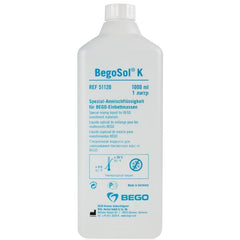
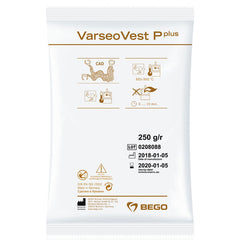
Bego
Bego VarseoVest P Plus Phosphate-Bonded Precision Investment, 72 x 250g (18kg)
011-1083
$175.54


Questions
What is Bego Wirofine Investment used for?
Bego Wirofine Investment is an investment material used in dental laboratories for casting procedures.
Which pack options are on this page?
This page carries 2 pack options: 45 × 400 g, 50 × 400 g (20 kg). Pick one to see its price, part number and stock.
When does it ship?
In-stock orders placed before 3 PM ET ship the same day; anything not on our shelf ships within 3 business days.Ground shipping is free over $10.
About chrome investment
Chrome investment is the investment sold for cobalt-chromium partial denture frameworks. The use of higher melting alloys has increased the use of phosphate-bonded investment.
A dental casting investment is a material consisting principally of an allotrope of silica and a bonding agent. The bonding substance may be gypsum, for lower casting temperatures, or phosphates and silica, for higher casting temperatures. In the lost-wax technique a wax pattern is surrounded with a refractory slurry that sets, the pattern is removed by heat, and metal or ceramic is cast into the mold that is left.
ISO 15912 covers casting investment, brazing investment, pressable-ceramic investment and refractory die materials, and classifies them by intended use and by the burn-out procedure the manufacturer recommends.
How the investments and duplicating materials on this shelf differ
- Universal Investment — Phosphate-bonded powder and its mixing liquid, sold for more than one kind of casting.
- Chrome Investment — For partial denture frameworks cast in a higher melting alloy.
- Pressable Ceramic Investment — The mold material for pressed ceramics, not for cast metal.
- Refractory Investment — Material for casts, dies and pegs that must go through the furnace.
- Duplicating Materials & Flasks — Gels, silicones and flasks for copying the master model in investment.
- Duplicating & Die Silicone — A silicone that makes the flexible mould of the master model.
What to look at when choosing an investment
Binder and temperature: gypsum is not chemically stable above 650 °C, so gypsum-bonded investments are typically restricted to castings of conventional gold alloys.
Expansion: high setting expansion has been reported for phosphate-bonded materials, more when they are mixed with a silica sol, the special liquid, than with water. Setting expansion was found to be sensitive to mixing speed and to the liquid to powder ratio.
Strength: investments are brittle and may fracture at clamping points.
Burn-out: ISO 15912 classifies investments by intended use and by the burn-out procedure the manufacturer recommends.
Sources: The Glossary of Prosthodontic Terms, 9th edition (J Prosthet Dent 2017) · ISO 15912:2016, Dentistry — Casting investments and refractory die materials · Diametral tensile strength of phosphate-bonded investment material under four drying methods, 2019 (PMC6685339) · ISO 14356:2024, Dentistry — Duplicating material · Fit of cast removable partial denture frameworks and the storage of wax patterns, 2015 (PMC4678543)
