

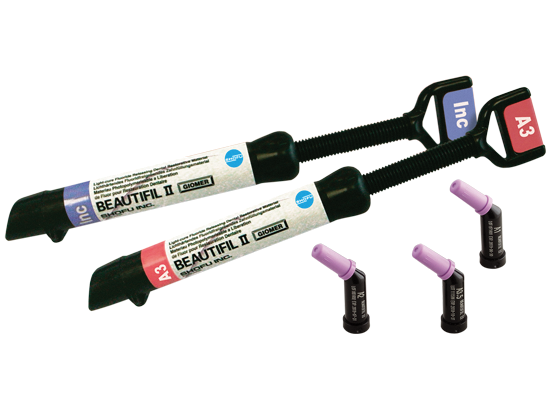
Shofu Beautifil II Cosmetic Kit is a nano-hybrid composite restorative kit for cosmetic (esthetic) procedures.
Shofu Beautifil II Cosmetic Kit is a composite kit from Shofu, part of the Beautifil line. Key facts — Type: Packable; Cure: Light; Filler load: 83.3 %; Filler class: Nanohybrid. Manufacturer part number 1777.
Find it on our Restorative & Cosmetic shelf, under Composites.
Orders placed before 3 PM ET ship the same day when the item is on our shelf (otherwise within 3 business days), and ground shipping is free over $10.
| Type | Packable |
|---|---|
| Cure | Light |
| Filler load | 83.3 % |
| Filler class | Nanohybrid |
| Depth of cure | 5.9 mm |
| Bioactive | Yes |
| Radiopaque | Yes |
| Filler technology | S-PRG (Giomer) |
| Flexural strength | 130 MPa |
| Compressive strength | 330 MPa |
Product
- Manufacturer
- Shofu
- Manufacturer #
- 1777
- Item code
- 102-0518
- UPC / Barcode
- 1777
Catalog path
- Marketplace
- Clinical
- Category
- Restorative & Cosmetic
- Subcategory
- Composites
Ordering
- Status
- Ships from the manufacturer
More from Composites
Stocked in the same subcategory.


Veratiq Dental
Veratiq Etchera 37% Phosphoric Acid Etchant Gel
In stock
229 sold this monthfrom $5.69
Questions
What is Shofu Beautifil II Cosmetic Kit used for?
Shofu Beautifil II Cosmetic Kit is a nano-hybrid composite restorative kit for cosmetic (esthetic) procedures.
When does it ship?
In-stock orders placed before 3 PM ET ship the same day. An item we don't keep on the shelf shows its own ship-by date on its page, and you can cancel it for a full refund until it ships.Ground shipping is free over $10.
About composite kits
A dental composite kit is one box holding several shades or viscosities of a single composite line, in place of one syringe at a time. Shade and colour stability are among the properties the ADA specification for resin filling materials sets requirements for.
A dental composite is a tooth-coloured filling material made of a resin matrix, an inorganic filler and a coupling agent that joins the two. The ADA lists resin-based composite as one of four families of direct restorative material, with amalgam, glass ionomer and resin-modified glass ionomer. Composites are grouped by resin type, filler particle size or the way they cure, and the groups overlap.
The FDA regulates composite as tooth shade resin material, a Class II device (21 CFR 872.3690). ISO 4049 is the international standard for polymer-based restorative materials.
How the types of composite differ
- Universal composites — The general-purpose paste, thicker than a flowable because it carries more filler. Light-cured composite of this kind is placed in layers of about 2 mm.
- Flowable composites — Thinner, because it carries less filler: it flows and adapts to the cavity more easily, but is more open to wear and shrinks more on curing than denser composites. The ADA describes flowables as typically used as a liner or base, or in low-stress areas.
- Bulk-fill composites — Placed in one layer of about 4 mm instead of several 2 mm layers. It comes as a thin base material that is covered with a conventional composite, or as a full-body paste that needs no covering.
- Composite kits — Several shades or viscosities of one line in a single box, in place of one syringe.
Packable composites, made with coarse or high-fraction filler so they can be condensed in back teeth, sit at the other end of the same scale from flowables. There is no separate packable shelf here.
What to look at when choosing a composite
Filler and viscosity: viscosity rises with filler loading, and more filler is what improves resistance to wear.
Layer depth: bulk-fill products have been marketed with increment depths from 4 to 10 mm. The depth that actually cures also depends on the light, the exposure time, the shade and the translucency.
Strength class: ISO 4049 sets a minimum flexural strength of 80 MPa for materials the maker claims for chewing surfaces and 50 MPa for all others.
Radiopacity: under ISO 4049 a flowable composite should be at least as radiopaque as the same thickness of aluminium, and a systematic review reported that a number of flowables on the market were not.
Shade: studies found that a flowable and the universal composite of the same line differ in colour, translucency and fluorescence, so the same shade name is not a guaranteed match.
Sources: ADA Oral Health Topics: Materials for Direct Restorations · FDA 21 CFR 872.3690, Tooth shade resin material · ISO 4049:2019, Polymer-based restorative materials · Composition, Physicomechanical, and Clinical Behaviour of Nanohybrid Resin Composites: A Narrative Review (PMC13706303) · Baroudi & Rodrigues 2015, Flowable Resin Composites: A Systematic Review (J Clin Diagn Res) · Van Ende et al. 2017, Bulk-Fill Composites: A Review of the Current Literature (J Adhes Dent) · Clinical Effectiveness of Bulk-Fill and Conventional Resin Composite Restorations: Systematic Review and Meta-Analysis (PMC7464794) · Chesterman et al. 2017, Bulk-fill resin-based composite restorative materials: a review (Br Dent J) · Peer-reviewed restatement of ISO 4049:2019 strength classes (PMC12649971)
